woensdag 27 november 2019

LECT: Boekvoorstelling "In de kunst gelogeerd: Kunstenaarsherbergen op het Belgische platteland (1840-1914)"

"In de kunst gelogeerd: Kunstenaarsherbergen op het Belgische platteland (1840-1914)"
Voorstelling van het boek van Marie Becuwe, met lezingen van prof. dr. Marjan Sterckx en Arnold Eloy
Emile Van Dorenmuseum, Genk 
Zondag 8 december 2019
RSVP'en: vóór vrijdag 6 december 2019

Uitnodiging voor de voorstelling van het boek "In de kunst gelogeerd: Kunstenaarsherbergen op het Belgische platteland (1840-1914)" door Marie Becuwe (Mens en Cultuur Uitgevers, 2019)

Veel kunstliefhebbers kennen de ‘Auberge Ganne’ in het Franse dorpje Barbizon of het ‘Hotel Spaander’ in het Nederlandse Volendam, maar weinigen weten dat ook België in de tweede helft van de 19de eeuw enkele spraakmakende kunstenaarsherbergen kende. De opkomst van de landschapsschilderkunst en plein air voerde steeds meer schilders naar het ‘ongerepte’ platteland. De beperkte mobiliteit verplichtte hen om enige tijd in een plaatselijke herberg te verblijven.

"In de kunst gelogeerd" voert u mee langs de Belgische plattelandsherbergen die onder kunstenaars vaste adressen werden en uitgroeiden tot artistieke ontmoetingsplaatsen. In logementshuizen als ‘Au Renard’ in Tervuren, ‘Hôtel de la Cloche’ in Genk, ‘Het Pannenhuis’ in Kalmthout, ‘De Keizer’ in Wechelderzande, ‘Le Cygne’ in Knokke en ‘Au Repos des Artistes’ in Anseremme schoven talloze kunstenaars jarenlang aan de tafel aan. Schilders als Théo Van Rysselberghe, Hippolyte Boulenger, Félicien Rops, Anna Boch en Henry Van de Velde, namen er plaats naast schrijvers, dichters, beeldhouwers en fotografen.

In veel gevallen betaalden ze de genereuze herbergiers in schilderijen en vierden ze hun creativiteit bot op de muren, plafonds, vensters, deuren en meubels van de herberg. Onder de gasten werden vriendschappen gesmeed en artistieke inzichten en technieken uitgewisseld die het verzet tegen de academische landschapstraditie aanscherpten.

De kunstenaarsherbergen lagen aan de basis van diverse schildersdorpen en speelden een cruciale rol in de ontwikkeling van de realistische en impressionistische landschapsschilderkunst in België. Toch raakten deze plaatsen in de loop van de 20e eeuw snel vergeten. Met "In de kunst gelogeerd" krijgen de kunstenaarsherbergen, hun uitbaters en hun artistiek cliënteel een postuum eerbetoon en opnieuw een voorname plaats in de Belgische kunstgeschiedenis.

Het volledige programma van de voorstelling vindt u in de bijgevoegde uitnodiging. U wordt gevraagd uw aanwezigheid te melden vóór vrijdag 6 december, hetzij via e-mail (info@mens-en-cultuur.com), hetzij telefonisch (op het nummer 0496 805 799).

maandag 18 november 2019

CFP: Appearing/ Revealing/ Disappearing: Cultural practices of staging in 19th-century France

CFP: Appearing/ Revealing/ Disappearing: Cultural practices of staging in 19th-century France
University of Lausanne
26-27 March 2020
CFP deadline: 10 December 2019


Generally associated with the theatrical practice and with the performance, the notion of staging played a central role throughout the whole 19th century. The post-revolutionary period largely contributed to develop a process of appearing, disappearing and revealing, intended as the possibility to be seen and to make the self visible on the occasion of socio-cultural and artistic events. The reaction to the turmoil generated by the 1789 Revolution and the austerity engendered by the Terror regime gives evidence of this capacity of juggling the necessity of being seen and the act of disappearing. This aspect will increasingly develop during the 19th century, evidently supported by the growth of the industry of entertainment, the diversification of drama and performances and the mass production of visual culture.
Within this context, staging becomes a way for an individual or a group of individuals to integrate a community. It also represents a bridge between the understanding of the process of appearing and its materialization, a link between the artistic, visual and literary spaces. This symposium aims at discussing mechanisms and patterns surrounding this process by focusing on the multiple references which shaped the act of appearing and disappearing.
Special attention will be paid to the cultural media enabling the staging, such as popular and/or satirical images, theatrical representations, entertainment industry, photography, but also the spatiality related to the staging. The heterogeneous character of these manifestations fosters a multidisciplinary approach which largely relies on transmediality, permeability of points of view and cross-cultural exchanges.

Potential topics could be:

Staging in visual arts
- Representations of staging
- Impact of images on the social status of staging
- Staging through the image: printmaking, caricature, photography
- Staging through the movement, the animated image and the projection

Materialities of staging
- Staging through theatrical performances
- Staging through the industry of entertainment
- Cultural practices linked to the organization of shows
- Diversification of the modalities of staging

The cult of performance
- Permeability of medias and genres
- Representation of the self and of the other
- Actors and personifications

The space of staging
- Space as catalyst for staging and the relationship to the audience
- Spatiality and interactions of staging
- The literary space between fiction and theatrical genres

Proposals (maximum 250 words), in French or English, have to be sent, together with a short bio-bibliography (maximum 500 words) to Camilla Murgia at the following address: camilla.murgia@unil.ch, by December 10, 2019. Accepted papers will be notified by the end of
December 2019. Papers will be published in an edited volume.

The conference is sponsored by the Faculty of Humanities, department of History of Art, University of Lausanne and the SHC (Centre des Sciences Historiques de la Culture), University of Lausanne. There is no registration fee for the conference.

vrijdag 8 november 2019

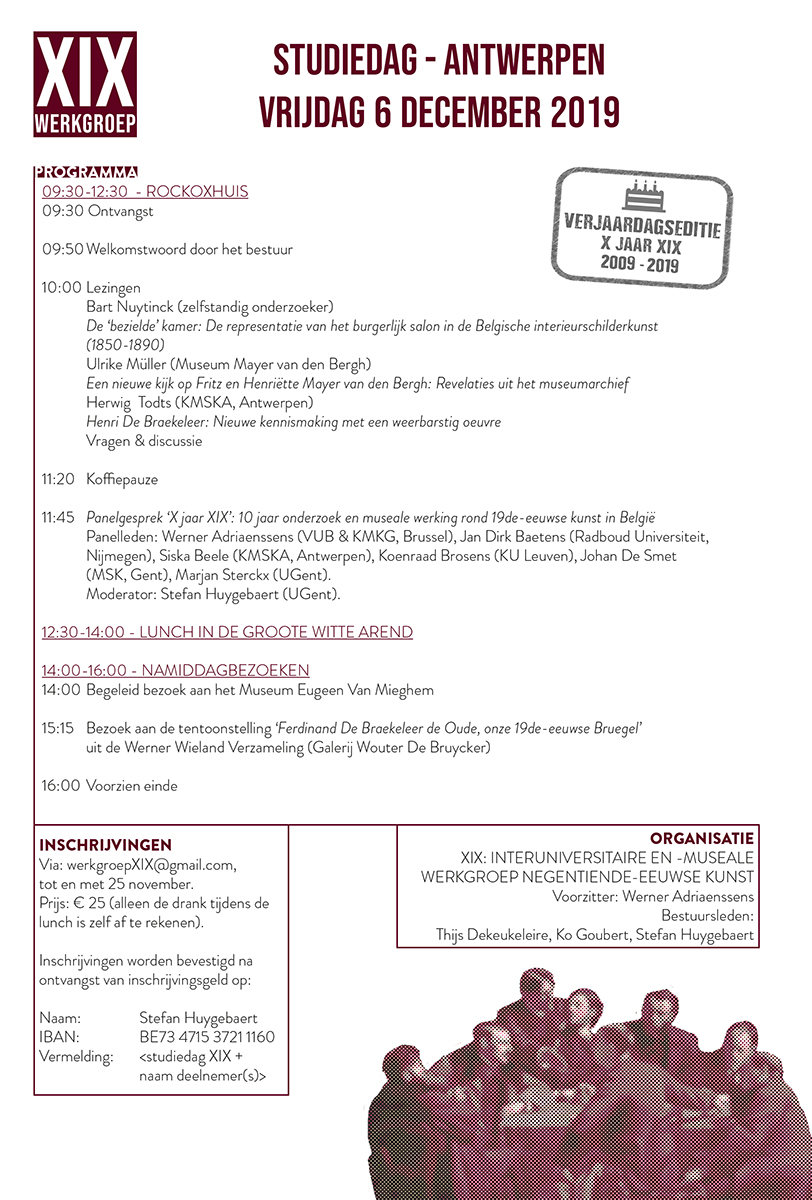
CONF: Interuniversitaire en intermuseale studiedag XIX

CONF: Interuniversitaire en intermuseale studiedag XIX
Werkgroep XIX
Rockoxhuis, Antwerpen (Keizerstraat 12)
Vrijdag 6 december 2019
Inschrijvingsdeadline: 25 november 2019


Op vrijdag 6 december 2019 vindt de jaarlijkse studiedag van de Werkgroep XIX plaats in Antwerpen. Het wordt ditmaal een erg feestelijke editie: met de leuze 'X jaar XIX' vieren we het tienjarig bestaan van de werkgroep, die inderdaad het levenslicht zag in het najaar van 2009. We ontvangen u graag vanaf 9u30 in het Rockoxhuis (Keizerstraat 12). De voormiddag bestaat uit drie prikkelende lezingen, en daar laten we voor deze bijzondere gelegenheid een panelgesprek aan aansluiten over 10 jaar onderzoek en museale werking rond 19de-eeuwse kunst in België, om terug te blikken én vooruit te kijken. Na een gezamenlijke lunch volgt een museum- en een tentoonstellingsbezoek.

Bovenstaand vindt u het volledige programma terug, alsook de praktische modaliteiten voor de inschrijving.

Om de kosten van de organisatie te dekken zijn wij verplicht een bijdrage van € 25 per persoon aan te rekenen. Locatie, middagmaal e.d.m. zijn daarin inbegrepen; alleen de drank bij de lunch wordt ter plaatse (contant en individueel) afgerekend. De rekeninggegevens voor betaling per overschrijving zijn vermeld in het programma.

De inschrijving wordt geregistreerd bij de ontvangst van deze bijdrage én bij het doorgeven van uw menukeuze via werkgroepXIX(at)gmail.com :
a. Stoofvlees met salade en frietjes,
b. Vegan curry van Belgische groenten (gluten- en lactosevrij), of
c. Sliptong met oventomaat en frietjes

Alle geïnteresseerden zijn van harte welkom. Inschrijvingen lopen tot en met maandag 25 november.

maandag 21 oktober 2019

CFP: Thinking in the Box: The Benefits of Artistic Tradition in the Nineteenth Century (ESNA, The Hague)

CFP: Thinking in the Box: The Benefits of Artistic Tradition in the Nineteenth Century
Organised by the European Society for Nineteenth-Century Art (ESNA)
The Hague, RKD – Netherlands Institute for Art History
Keynote: Liz Prettejohn (University of York)
14-15 May 2020

Submission deadline: 20 December 2019 

Frederic Leighton, The music lesson, 1877, oil on canvas, 93 x 95 cm, Guildhall Art Gallery, London, UK

"Poetry and progress are like two ambitious men who hate one another with an instinctive hatred, and when they meet upon the same road, one of them has to give place."

Charles Baudelaire, Salon of 1859

Tradition is art history’s eternal Other: it is that which must be overcome, resisted, thrown off or, if a compromise must be made, creatively appropriated. The history of the art of the nineteenth century, that “great” age of innovation, progress and revolution, is more than any other rooted in anti-traditionalist sentiment, steeped in a rhetoric that privileges innovation and bound to narrative structures geared against artistic tradition. Modernist and other teleological histories of nineteenth-century art have always emphasised change and novelty. But even revisionist accounts of the art of the nineteenth century leave scarcely any room to consider tradition in its own right. These have generally either sung the aesthetic praises of traditional art without much further reflection, or have discussed academic art as innovative in another way, either within a traditional framework or in the sense that the art under consideration points forward to developments other than those associated with formal modernism.

This rejection of artistic tradition may be due to its use in fascist and totalitarian ideologies, but is also the result of a structuralist approach within the discipline of art history that continuously opposes new and old (with “old” always being the marked term). Ironically, this structural divide is in part a product of the nineteenth century itself: it stems from the rising historical (and art-historical) consciousness of the time and its clash with a strong belief in change and progress. This all-too-simple opposition between what was and what will be still shapes our understanding of the artistic act. True art, it seems, must be the creation of something out of nothing—a belief stemming from the early-nineteenth-century romantic philosophy of art and, later, a major tenet of modernist criticism. The result has been that art historians are rarely able to think around the categories of tradition and innovation and nearly always address tradition solely as a problem. Seldom is the richness of artistic tradition itself explored.

The question remains whether this rejection of artistic tradition does justice to what art really is, or, better, what it was understood to be in the nineteenth century. For Charles Baudelaire, the answer would have been in the negative. In his Salon of 1859, he observed that “poetry and progress are like two ambitious men who hate one another with an instinctive hatred”. This conference invites papers that consider artistic tradition not as the nemesis of creation but in its own right. It aims to examine the potential artistic, commercial and even political benefits of thinking in the box—of continuing artistic tradition(s), working within them or reverting to them during the (long) nineteenth century. What could tradition yield for artists and the way they understood their art that innovation could not? What could it do for audiences and what they might have sought in artworks? What could it achieve for patrons, with their various social, political and aesthetic agendas? We invite papers that deal with the “problem” of tradition in nineteenth-century art, but which do not address the phenomenon itself as a problem. We especially welcome proposals that explore or develop new theoretical paradigms to study the relationship between nineteenth-century art and artistic tradition.

Subject that papers may address include:

- Patterns of artistic imitation and emulation;
- Historical and academic pastiche and its collectors;
- “Retrograde” and “reactionary” art;
- Antoine Compagnon’s “anti-moderne” in the visual arts;
- William Marx’s “arrière-garde” in the visual arts;
- Reconsidering or rethinking Harold Bloom’s concepts of “anxiety of influence” and “belatedness”;
- Political uses of artistic tradition or traditional art (local, regional and national);
- The geography of tradition: metropolitan and provincial attitudes towards tradition;
- Class, gender and “race” in the face of artistic tradition;
- Markets for traditional art;
- Academic theory and art education (e.g. drawing manuals, plaster copies, museums and academic collections of copies);
- Non-avant-garde art criticism and art discourse;
- Processes of art historical canonisation (e.g. in scholarship, popular publications, pantheons of art, collecting practices, etc) and the dialogue between contemporary art and the Old Masters.

Please send proposals (max. 300 words) for a 20-minute paper in English, French or German and a brief CV to esnaonline@hotmail.com by 20 December 2019 at the latest. Selected speakers will be contacted in January 2020.

Organising committee: Jan Dirk Baetens (Radboud University Nijmegen), Mayken Jonkman (RKD – Netherlands Institute for Art History, The Hague) and Myrthe Krom (Museum Gouda).

Scientific committee: Maite van Dijk (Van Gogh Museum, Amsterdam), Rachel Esner (University of Amsterdam), Liz Prettejohn (University of York), Jenny Reynaerts (Rijksmuseum, Amsterdam), Marjan Sterckx (Ghent University), Chris Stolwijk (RKD – Netherlands Institute for Art History, The Hague, and University of Utrecht).

www.esnaonline.wordpress.com

woensdag 16 oktober 2019

EXH: Retrospectieve Ferdinand De Braekeleer de Oude, onze 19de Eeuwse Bruegel (Antwerpen)

Retrospectieve Ferdinand De Braekeleer de Oude, onze 19de Eeuwse Bruegel
Schilderijententoonstelling uit de Werner Wieland kunstverzameling
Galerij Wouter de Bruycker, Wolstraat 26, Antwerpen
4 tot 23 december 2019


Tussen woensdag 4 en zondag 23 december 2019 houdt de Werner Wieland Verzameling een retrospectieve tentoonstelling over de Antwerpse schilder Ferdinand De Braekeleer de Oude, onze negentiende-eeuwse Bruegel, de voornaamste vertolker van het Vlaamse volksleven in de romantische negentiende eeuw. Het is de eerste keer sinds 1936 dat deze merkwaardige virtuoos van het romantische genre opnieuw gehuldigd wordt in zijn geboortestad en in Vlaanderen, ditmaal met een twintigtal tentoongestelde werken uit de Werner Wieland Verzameling, waarvan twaalf van zijn eigen hand, een achttal van sommigen van zijn bekendste leerlingen uit de De Braekeleer School.

Praktisch

Het unieke evenement vindt plaats in kunstgalerij Wouter De Bruycker, Wolstraat 26, 2000 Antwerpen, in het hart van de historische stad, dicht bij de Grote Markt en de kerstmarkt en de Melkmarkt, onder meer te bereiken via tramlijn 11.

Openingsuren zijn van woensdag tot zondag, van 12 tot 19 uur, ook op zaterdagen en zondagen. Maandag en dinsdag gesloten. Bezichtiging is gratis. Programma met biografie en lijst der schilderijen ter plaatse verkrijgbaar aan € 1. Bezichtiging ten allen tijde beperkt tot maximaal 20 personen in de galerij.

Rondleidingen: reservaties op voorhand via info@wernerwieland.eu Groepsrondleidingen van een uur zijn mogelijk in de avond of tijdens openingsuren aan € 10 per persoon. Tijdens openingsdagen vindt ook elke avond om 19 uur een rondleiding plaats van ongeveer een uur over de schilder en de tentoongestelde werken, kost € 10 per persoon, maximaal 20 personen.

Een kleurencatalogus van vorige Werner Wieland tentoonstellingen en Werner Wieland romans worden eveneens te koop aangeboden.

De Werner Wieland Verzameling is een van de uitgebreidste kunstverzamelingen gespecialiseerd in 19de-eeuwse romantische, academische, neogotische en neorenaissance schilderijen uit de gezamenlijke Nederlanden. Het is de grootste private houder van zulke kunst ter wereld uit Vlaanderen en omvat onder meer een van de meest volledige overzichten van zulke kunst van schilders uit de wereldberoemde Antwerpse en Brusselse Kunstacademies. De collectie is genoemd naar haar stichter, de Vlaamse schrijver Werner Wieland.