Posts tonen met het label conference. Alle posts tonen

dinsdag 26 april 2022

CONF: Ways of Studying: Towards New Histories of Nineteenth-Century Art

 'Ways of Studying: Towards New Histories of Nineteenth-Century Art'

ESNA Conference 2022
Organized by ESNA (European Society for Nineteenth-Century Art), RKD – Netherlands Institute for Art History, The Hague and NWO (Netherlands Organisation for Scientific Research)
19-20 May, 2022: 
Online via Zoom 

The annual ESNA Conference 2022, Ways of Studying: Towards New Histories of Nineteenth-Century Art, expands on this initial phase of reflection, setting it in an international context. We understand the conference as a kind of laboratory, a place for experiment and exchange. Taking a two-pronged approach, the papers will take case studies as their starting point, but also pinpoint and further explore the implications of these new discoveries for the field in general. In this way, the conference presents new information and address questions of methodology, i.e. “ways of studying”.

For the full program and registration details, click here.

dinsdag 26 oktober 2021

CFP: Ways of Studying: Towards New Histories of Nineteenth-Century Art

Call for Papers: Ways of Studying: Towards New Histories of Nineteenth-Century Art
Organised by the European Society for Nineteenth-Century Art (ESNA)
The Hague, RKD – Netherlands Institute for Art History
Date: 19-20 May 2022
Submission deadline: 17 December 2021

In the autumn of 2020, the Van Gogh Museum, in collaboration with ESNA and the University of
Amsterdam, organized a series of roundtable discussions that from various angles sought to address
the question of “diversifying” the canon of nineteenth-century art and making art-historical practice
more “inclusive.” The aim of these meetings, followed up in January 2021 by the annual ESNA
Winter Seminar on the same topic, was to formulate concrete research strands, which, rather than
simply broadening the nineteenth-century canon, would substantially change it. Ideally, these would
give direction to university teaching, exhibitions, and collection building over the next five years.

It soon became clear, however, that the terms “diversification” and “inclusion” were in themselves
problematic, as they imply that the current disciplinary system would remain intact. One might study
art from other parts of the world or by “Other” creators, one might expand the canon, but the idea
that the history of nineteenth-century art followed a certain developmental pattern, one that
culminated in an avant-garde that then went on to shape Modernism, would not necessarily be
affected. Instead, one might better seek to fundamentally decolonize the history of nineteenth-
century art. This term, too, is not unproblematic: it has a particular historical dimension, but in
recent times has come to stand more generally for a call to both recognize and challenge hierarchies
in and beyond the academy and the art world, not only those resulting from concrete actions in the
(colonial) past but also those linked to questions of class, gender, race, and ethnicity. Ideally, a
decolonized history of nineteenth-century art would not only add new voices and objects to the
existing canon but would productively mobilize the awareness of the ways in which what we study,
teach, and display reflects European hegemony. Although this topic is clearly not new, even in the
study of nineteenth-century art, specific recent events and debates, as well as fundamental shifts
within both academia and society at large, lend it a particular sense of urgency.

The study of the nineteenth century can look back on a history of self-renewal and has in the past
been the vehicle for the revitalization of the field of art history as whole. In this sense, we see this
conference – together with those organized by our colleagues in other parts of the world – in the
tradition of the so-called “new art history.” We seek to build on the studies of the seminal figures of
the 1970s, 80s and 90s, those who brought new methods to bear on research into objects both
known and unknown and thereby changed the perspective on the period as a whole.

The annual ESNA Conference 2022, Ways of Studying: Towards New Histories of Nineteenth-
Century Art, will expand on this initial phase of reflection, setting it in an international context. We
understand the conference as a kind of laboratory, a place for experiment and exchange. Taking a
two-pronged approach, we seek papers that take case studies as their starting point, but which also
pinpoint and further explore the implications of these new discoveries for the field in general. In this
way, the conference will present new information and address questions of methodology, i.e. “ways
of studying”.

We seek papers which can serve to disrupt and restructure the field of nineteenth-century art
history both in terms of content and method. Proposals should therefore explicitly address the wider
implications of the chosen case study.

Topics may include, but are not limited to:
• makers from diverse ethnic and gender communities
• works of indigenous or first-nation artists
• neglected objects, media, and genres
• examinations of institutional structures and non-canonical spaces of display
• rethinking geographies of creation
• networks and exchange between Europe and the global south

We particularly encourage the input of junior scholars.

Please submit an abstract of 300 words and your CV by 17 December 2021 to
esnaonline [at] hotmail [dot] com.

Selected speakers will be contacted in January 2022.

dinsdag 14 september 2021

CONF: Congres Cultures of Belgian Space (15-16 Oct. 2021, Hingene)

Internationaal congres Cultures of Belgian Space - Cultures de l'Espace belge (1850-1924)

15 - 16 October

Kasteel D'Ursel (Hingene) & Emile Verhaerenmuseum (Puurs-Sint-Amands) 

Organ.: KU Leuven i.s.m. UGent & ULB, en met de steun van FWO, FNRS & lokale partners

Keynote: Patrick McGuinness (St Anne's College, Oxford, UK) 

Programma hier.

maandag 23 november 2020

CONF: The Afterlife of Medieval Sculpture. 7th Annual Ards Conference (online webinar)

The Afterlife of Medieval Sculpture.
Ards 7th annual colloquium on Current Research in medieval and renaissance sculpture 
Online webinar
3, 4 and 10 December 2020

Image: The decorated ceiling and hanging rood in the Metropolitan Cathedral & Basilica of Saint Chad, Birmingham, by A.W.N. Pugin (detail)

The 7th ARDS annual colloquium, which celebrates new research in the field of renaissance and medieval sculpture will focus on the theme of the Afterlife of medieval sculpture. The Ards conference in 2017 in Paris already touched upon the theme of the Collecting of Medieval sculpture and at Ards 2018 in Utrecht, Michael Rief provided the participants with a very interesting keynote on the repurposing of (amongst others) some Mechelen Christ child statues. This year the organisation wants to explore the theme of the ‘nachleben’ (afterlife) of medieval sculpture in more depth. The idea of ‘nachleben’ is to be understood in a broader sense than the pure Warburgian interpretation. Not only the ‘nachleben’ of the image, but also that of the object is of interest for the study of sculpture.

How were medieval and late-gothic sculptures used, understood, copied, altered, re-used, recycled, repurposed and treated (or mistreated) in the centuries after the moment of their production? From the medieval period until the present, Gothic art has undergone shifts in taste and appreciation. Nowadays prices for medieval art are soaring at auctions but in the 17th and 18th centuries many churches and cloisters were refurbished in the style of the period and medieval art and furniture had to make room. And e.g. in the 1790’s many churches were stripped of their medieval furniture (if extant) and they were sometimes sold by the pound if not thrown away or burnt. Even in the fifteenth century, some sculptures made in the earlier Middle Ages were restored, remade, cleaned and polished, whereas others were neglected.

The conference committee consists of dr. Jessica Barker (The Courtauld Institute of Art), dr. Peter Carpreau (M Leuven/Ards), dra. Marjan Debaene (M Leuven/Ards), drs. Lloyd De Beer (The British Museum) and dra. Michaela Zöschg (Victoria and Albert Museum).

A record number of proposals allowed the organisation to select a fascinating and diverse program in 4 large thematic sessions, with 25 speakers, over 3 conference days via Teams, due to COVID-19 restrictions.

The full program is online.

Registrations for the webinar are now open.

donderdag 25 juni 2020

CFP: ESNA Talks 2020

CFP: ESNA Talks 2020
European Society for Nineteenth-Century Art (ESNA) & RKD – Netherlands Institute for Art
History

Filmed presentations on digital platform
CFP deadline: 4 September 2020


Théodore Géricault, Le Radeau de la Méduse, 1818, Paris, Musée du Louvre
Due to the worldwide pandemic, ESNA has had to postpone its conference Thinking in the Box to the spring of next year (27-28 May 2021). In lieu, it will initiate ESNA Talks, an online platform for the presentation of current research into the art and culture of the long nineteenth century.

Researchers are invited to submit an abstract for a digital presentation of between 10 and 20 minutes on a topic of their choice, to esnaonline@hotmail.com. In honor of the seventh anniversary of ESNA’s activities, ESNA will choose seven submissions to be presented online in mid-November. Ideally, abstracts should be submitted on film: one or two slides in a PowerPoint as a filmed presentation. The deadline is 4 September 2020.

The selection of talks will be made by the beginning of October, with the presentations themselves due on 6 November 2020. The talks will be published online via the ESNA website and the website of the RKD under one of the creative-commons licenses. Attention will be generated on social media, via the press and via ESNA's partners.

For ESNA's open letter, which includes the CFP, click here.

vrijdag 17 januari 2020

CONF: ESNA Winter Seminar 2020 (Den Haag)

ESNA Winter Seminar 2020
Eyeopeners: Inspirerende inzichten voor de studie van negentiende-eeuwse kunst
RKD, Den Haag
Vrijdag 31 mei 2020

Programma:

13:00 Inloop en registratie

13:30 Welkom en inleiding

13:45 Sessie 1 – “Klassiekers in nieuw licht”
Rachelle van den Broek: David Lowenthal, “Fabricating Heritage” in History and Memory, 10 (1998).
Mariëlle Ekkelenkamp: Pierre Bourdieu, “The Field of Cultural Production, or: The Economic World Reversed”, in The Field of Cultural Production (1993)
Naomi Bisping: Tentoonstelling en catalogus L’Invention du Passé, Musée des Beaux-Arts, Lyon en Monastère royal de Brou, Bourg-en-Bresse (2014)
Maaike Rikhof: tv-serie John Berger, Ways of Seeing (1972)
Evelien de Visser: Charles Dumas, “De Haagse School verzameld”, in De Haagse School: Hollandse meesters van de 19de eeuw (1983)

14:15 Discussie

14:30 Sessie 2 – “De impact van popular culture”
Anne-Marie Segeren: Tentoonstelling en catalogus L’impressionisme et la mode, Musée d’Orsay Parijs (2013)
Stefan Huygebaert: Delcampe.net als eyeopener binnen de postcard studies
Lotte Kremer: Tentoonstelling Prints in Paris 1900. Van Gogh Museum, Amsterdam (2017)

14:45 Discussie

15:00 Koffie/thee

15:45 Sessie 3 – “Buiten de grenzen van de canon”
Jorien Soepboer: Linda Nochlin. “Why Have There Been No Great Women Artists?” (1971)
Thijs Dekeukeleire: Queer: een nuttige categorie in kunsthistorische analyse
Malika M’rani Alaoui: Diary of H.M. the Shah of Persia. Europa door de ogen van de ‘ander’
Lisa Lambrechts: Denise Murrell, Posing Modernity. The Black Model from Manet and Matisse to Today (2018)
Myrthe Krom: Jan Koenderink en Andrea van Doorn, “Assemblage and Icon in Perception and Art”, in Art & Perception 1 (2013)

16:15 Discussie

16:30 Afsluiting

16:45 Borrel

Inschrijven:
Op de website van ESNA en het RKD staat vanaf heden het programma voor het ESNA Winter Seminar Eyeopeners: Inspirerende inzichten voor de studie van negentiende-eeuwse kunst.
Het seminar vindt plaats in het Nederlands Instituut voor Kunstgeschiedenis (RKD), Den Haag, aanvang 13.00 uur.
Tickets €15,-, voor studenten €10,-, verkrijgbaar via de webshop van het RKD.
Voor studenten uit Vlaanderen is er een reisvergoeding beschikbaar, voor meer informatie mail esnaonline@hotmail.com

maandag 18 november 2019

CFP: Appearing/ Revealing/ Disappearing: Cultural practices of staging in 19th-century France

CFP: Appearing/ Revealing/ Disappearing: Cultural practices of staging in 19th-century France
University of Lausanne
26-27 March 2020
CFP deadline: 10 December 2019


Generally associated with the theatrical practice and with the performance, the notion of staging played a central role throughout the whole 19th century. The post-revolutionary period largely contributed to develop a process of appearing, disappearing and revealing, intended as the possibility to be seen and to make the self visible on the occasion of socio-cultural and artistic events. The reaction to the turmoil generated by the 1789 Revolution and the austerity engendered by the Terror regime gives evidence of this capacity of juggling the necessity of being seen and the act of disappearing. This aspect will increasingly develop during the 19th century, evidently supported by the growth of the industry of entertainment, the diversification of drama and performances and the mass production of visual culture.
Within this context, staging becomes a way for an individual or a group of individuals to integrate a community. It also represents a bridge between the understanding of the process of appearing and its materialization, a link between the artistic, visual and literary spaces. This symposium aims at discussing mechanisms and patterns surrounding this process by focusing on the multiple references which shaped the act of appearing and disappearing.
Special attention will be paid to the cultural media enabling the staging, such as popular and/or satirical images, theatrical representations, entertainment industry, photography, but also the spatiality related to the staging. The heterogeneous character of these manifestations fosters a multidisciplinary approach which largely relies on transmediality, permeability of points of view and cross-cultural exchanges.

Potential topics could be:

Staging in visual arts
- Representations of staging
- Impact of images on the social status of staging
- Staging through the image: printmaking, caricature, photography
- Staging through the movement, the animated image and the projection

Materialities of staging
- Staging through theatrical performances
- Staging through the industry of entertainment
- Cultural practices linked to the organization of shows
- Diversification of the modalities of staging

The cult of performance
- Permeability of medias and genres
- Representation of the self and of the other
- Actors and personifications

The space of staging
- Space as catalyst for staging and the relationship to the audience
- Spatiality and interactions of staging
- The literary space between fiction and theatrical genres

Proposals (maximum 250 words), in French or English, have to be sent, together with a short bio-bibliography (maximum 500 words) to Camilla Murgia at the following address: camilla.murgia@unil.ch, by December 10, 2019. Accepted papers will be notified by the end of
December 2019. Papers will be published in an edited volume.

The conference is sponsored by the Faculty of Humanities, department of History of Art, University of Lausanne and the SHC (Centre des Sciences Historiques de la Culture), University of Lausanne. There is no registration fee for the conference.

vrijdag 14 juni 2019

CFP: The interiors of Art nouveau period : analyse, restore, make accessible (Brussel, 29-30 november 2019)

The interiors of Art nouveau period : analyse, restore, make accessible
Brussels, November 29 - 30, 2019
Deadline: June 16, 2019


The interiors of Art nouveau period : analyse, restore, make accessible

The Réseau Art Nouveau Network, a European network for the study, protection and enhancement of the Art Nouveau heritage, is celebrating its 20th anniversary this year.
Urban.brussels, founding member of RANN, is hosting an international symposium in Brussels, co- organised by RANN and urban.brussels in partnership with the Horta Museum and CIVA.

The research and progress of our knowledge of Art Nouveau has always been one of RANN's primary objectives. If Art Nouveau is accessible to everyone in the street itself and while the Art Nouveau facades are the ornament of many European cities, the interiors arouse both from the academic world as from the general public many questions related to their accessibility, to their knowledge, to the refined restorations that they require.
This topic of interiors has not yet been scientifically exploited transversally in Europe; the aim of this symposium is to bring about a confrontation on research practices, understanding, conservation and enhancement of Art Nouveau interiors, in order to identify new research perspectives.

Four themes will be addressed :

1. KNOW. Current status: sources and new approaches
How to apprehend the interiors of the Art Nouveau period? Many sources are available to the art historian: plans, photographs, descriptions, articles, drawings... How to approach, decrypt and analyse such sources? Can the use of other sources and documents improve our knowledge of Art Nouveau interiors? In this context what status to be given to literary sources or paintings of the same period? These are the different research leads proposed. This approach enable to better understand the issues and new techniques developed by historians and art historians.

2. UNDERSTAND. Architectural fittings and decorative sets
The Art Nouveau interiors correspond to uses and are rooted in a very special symbolism. The use value enables to better understand the programme at the origin of a building; the programme being itself modeled on lifestyles and use of specific spaces of the end-of-century period. But the Art Nouveau interiors are also often the result of a symbolism in which colors, ornaments and decoration agree to create a harmonious and totalising ensemble. Without a refined analysis of these two values (use and symbolism), the whole understanding of the building risks being jeopardised. The researchers will offer unseen and innovative analyses of these two fundamental aspects of Art Nouveau interiors.

3. RESTORE. Approaches, techniques and new resources
The restoration of an Art Nouveau building involves many stakeholders: architects, restorers, craftsmen, art historians. The word will be given to them. New study techniques enable to prepare at best a restoration. Other more traditional approaches remain essential and require rigorous interpretations. In situ researches in which restorers and craftsmen play a key role will be addressed in this theme. Case studies as well as communications dedicated to questions and issues related to all restorations are welcome.

4. LIVE AND OPEN. Accessibility and contemporary issues
How to make a listed Art Nouveau building live? What are the problems faced by the owners (private, foundation, museum, state body...)? How to accommodate the different users as well as possible? Contemporary life, such as the use of an Art Nouveau building and therefore its interior spaces, raises many questions as the right balance between conservation and use is difficult to achieve.

The RANN also wishes to give the floor to young researchers: 25% maximum of the symposium lectures will be reserved for them (theses or dissertations defended or in the writing process).
The RANN cannot assure participants yet that this anniversary symposium will result in a publication.

Practical arrangements
Interventions will be limited to 25 minutes.
The RANN will cover the justified real travel expenses (travel, accommodation) of the participants to a maximum amount of 200 euros.

Conditions of submission and schedule
Candidates are invited to send by email to alalleaume@urban.brussels by 16 June 2019 in French or in English:
- CV, including contact details of the candidate (e-mail address, phone) and possible bibliography of articles or books already published
- An abstract / summary of the communication (maximum 300 words) - For young researchers: two references

The RANN will inform the candidates of the selection of the Scientific Committee by 29 July 2019 at the latest.

Scientific committee
Guy Conde-Reis, Architect, Promotion Information, urban.brussels, Brussels, Belgium Tove Lande, Curator, Jugendstilsenteret og KUBE, Alesund, Norway Breda Mihelic, Researcher, Urban planning Institute of the Republic of Slovenia Ramona Novicov, University lecturer, University of Oradea, Faculty of Construction, Cadastre and Architecture
Valérie Thomas, Curator, Museum of the School of Nancy - Villa Majorelle - Nancy-Museums, Nancy, France Benjamin Zurstrassen, Curator, Horta Museum, Brussels, Belgium

Organisation members
Anne-Lise Alleaume, Bruxelles Urbanisme et Patrimoine, Réseau Art Nouveau Network Benjamin Zurstrassen, Horta Museum Erika Giuliani, Réseau Art Nouveau Network
For any questions, please contact the RANN Secretariat at alalleaume@urban.brussels. You cannot answer this call for papers but you would like to keep in touch with the Réseau Art
Nouveau Network for future scientific activities? Please contact alalleaume@urban.brussels.

Who are we?
The Réseau Art Nouveau Network, composed of institutions and experts from European Art Nouveau cities, was formed in 1999 to study, promote and help protect Art Nouveau heritage so it can endure for future generations to enjoy. We undertake a wide range of activities including exhibitions, publications, conferences and cultural exchanges aimed at adults, children, researchers and professionals. Certified as Cultural route of the Council of Europe since 2014, the Network also benefitted from the co-funding of the European Commission for several European projects of cooperation. artnouveau-net.eu

Urban.brussels (formerly Brussels Urbanism and Heritage) is an administration of the Brussels Capital Region. Its main purpose is to support the territorial development of the Brussels Capital Region in a sustainable way, by implementing the regional policy with regard to urbanism, movable and immovable cultural heritage and managing operational programmes for urban revitalisation. urban.brussels

vrijdag 3 mei 2019

CONF: Frictions and friendships. Cultural encounters in the nineteenth century

'Frictions and friendships. Cultural encounters in the nineteenth-century'
ESNA Conference 2019
Organized by ESNA (European Society for Nineteenth-Century Art), RKD – Netherlands Institute for Art History, The Hague and NWO (Netherlands Organisation for Scientific Research)
June 19-20, 2019: The Hague, RKD – Netherlands Institute for Art History


The exhibition The Dutch in Paris, which was on show in the Van Gogh Museum, Amsterdam and in the Petit Palais, Paris during the fall of 2017 and spring of 2018 respectively, aimed to visualize the artistic exchange between Dutch and French artists between 1789 and 1914. As part of a larger research project, set up by the RKD – Netherlands Institute for Art History, the exhibition generated so much response that ESNA, in collaboration with the RKD and NWO, decided to organize an international conference on the subject, focusing specifically on international as well as national and local points of encounter and how they facilitated artistic exchange.

For the full program and registration details, click here.

maandag 5 november 2018

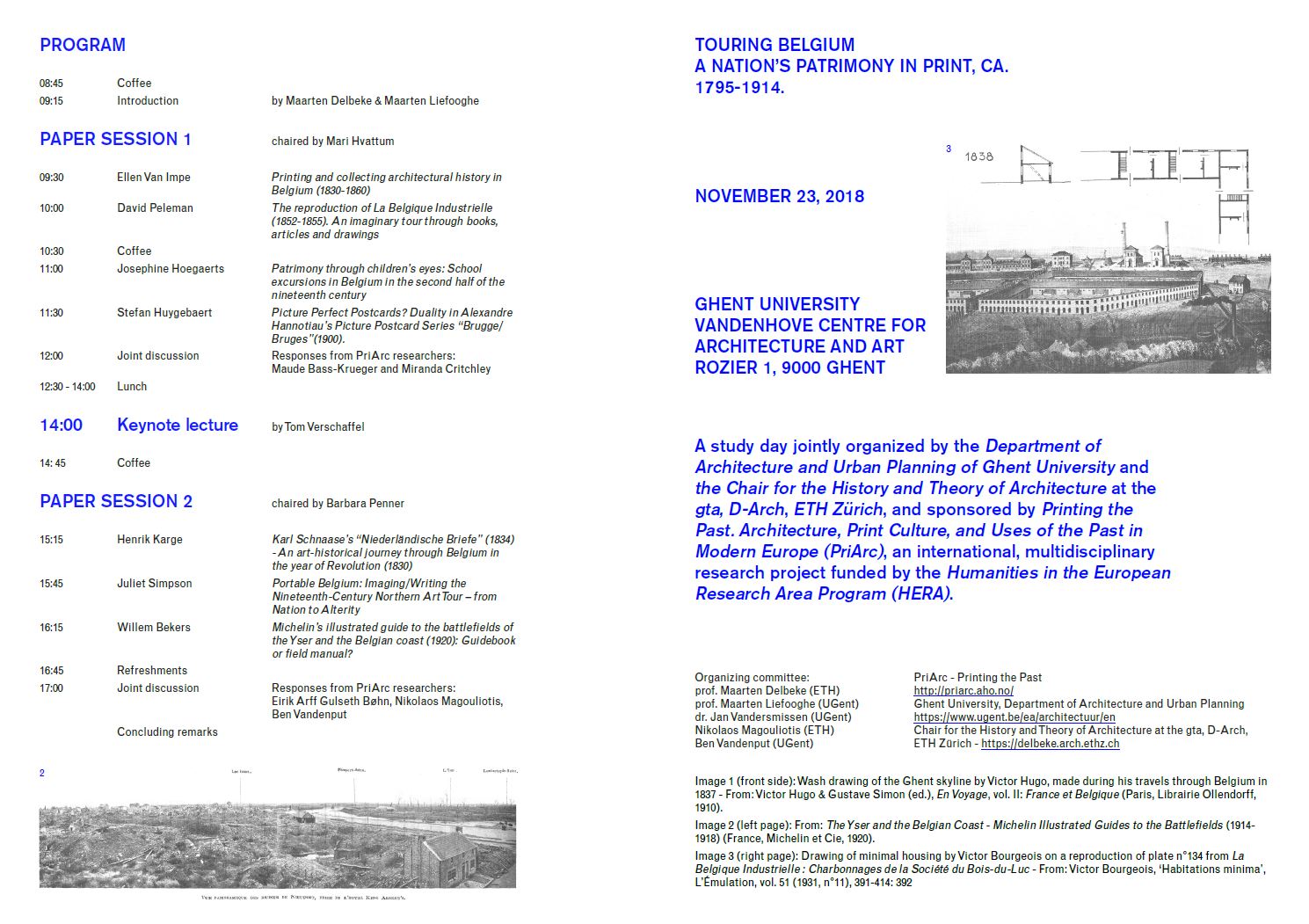
CONF: Touring Belgium - A Nation's Patrimony in Print, ca. 1795-1914 (Ghent, 23 November 2018)


Touring Belgium - A Nation's Patrimony in Print, ca. 1795-1914
Ghent University Vandenhove Centre for Architecture and Art
Rozier 1, 9000 Gent
Vrijdag 23 november 2018


Op vrijdag 23 november 2018 organiseert de Vakgroep Architectuur en Stedenbouw van de Universiteit Gent samen met de Chair for the History and Theory of Architecture (gta, D-Arch) aan de ETH Zürich een studiedag rond noties van het Belgisch patrimonium gedurende de lange negentiende eeuw. Bijzondere nadruk ligt op het architecturale erfgoed en in welke mate verschillende gedrukte media - van reisverslagen en albums tot gidsen en dagbladen - hebben bijgedragen aan het activeren van dit patrimonium in België en daarbuiten. Een keynote lecture zal verzorgd worden door professor Tom Verschaffel.


De organisatoren verwelkomen alle geïnteresseerden op 23 november vanaf 8u45 in het Vandenhove Centrum (Rozier 1, Gent). Het einde is voorzien rond 17u45.

Deelname is gratis maar de organisatoren vragen wel aan deelnemers om zich te registreren via de volgende link:
https://webappsx.ugent.be/eventManager/events/touringbelgium

De studiedag "Touring Belgium. A Nation's Patrimony in Print, ca. 1795-1914" maakt deel uit van Printing the Past. Architecture, Print Culture and Uses of the Past in Modern Europe (PriArc - http://priarc.aho.no/), een internationaal en multidisciplinair onderzoeksproject, ondersteund door het Humanities in the European Research Area Program (HERA).​