vrijdag 12 juli 2024

CFP: Celebrating James Ensor’s Modernity. New Perspectives

Dedicated to the 75th anniversary of the death of the Belgian artist James Ensor (1860-1949)


Location: University of Antwerp, Hof van Liere, Antwerp (Belgium)
Dates: 9, 10 & 11 December 2024
English spoken

Deadline: 15 September 2024
Contact person: Herwig Todts

The Royal Museum of Fine Arts Antwerp (KMSKA), in association with the University of Antwerp (ARCHES – Antwerp Cultural Heritage Sciences) & ARIA – Antwerp Research Institute for the Arts)), is organizing an international symposium on James Ensor to be held on Monday 9, Tuesday 10 and Wednesday 11 December 2024. The symposium ties in with the exhibition In Your Wildest Dreams. Ensor Beyond Impressionism, which the KMSKA is mounting in the autumn of 2024 as the final chord of the Ensor jubilee year. 

The symposium will bring together national and international researchers, who in recent years have shed new light on James Ensor, the painter, graphic artist, draughtsman and writer. At the same time, it aspires to build a bridge to the future so as to keep alive the interest in, research into and inspiration of (the cultural-historical context of) Ensor’s diverse practices. 

James Ensor is increasingly recognized as a crucial figure in the development of modern art. With his uncompromising visual language, the artist distanced himself from the classical European beauty ideal and the impressionism that had fascinated him initially. In his bold satire and masquerades with experimental forms and contrasting colours, Ensor presaged forerunners of expressionism like Edvard Munch and Vincent Van Gogh, as well as the surrealists. Around 1900, avant-gardists such as Wassily Kandinsky, Emil Nolde and Erich Heckel recognized him as an innovative artist who broke with classic Western European artistic values and traditions.

Furthermore, Ensor’s subjects and standpoints are still highly topical on today’s national and international art scene. His motifs, style and artistic personality resonate strongly with the practice of numerous contemporary artists. Indeed, themes like the mask and the grotesque, social criticism, ecology, identification with Christ, the crowd, satire and death have lost none of their relevance.  

We welcome papers exploring the rich and versatile career of James Ensor with a fresh contextualization in the broader artistic, cultural and historical fabric of the fin de siècle and first decades of the 20th century. We also invite reflections on Ensor’s legacy on contemporary art practices and artistic research. Topics should draw on Ensor’s oeuvre and career and may include, but are not necessarily limited to:

  • artistic/intellectual friendships and their impact on creativity 
  • styles and motifs 
  • specific works or clusters of works 
  • materials and technique (paintings, graphics, drawings) 
  • private collectors and public collections 
  • theoretical reflections on Ensor’s modernity 
  • interrelationships between the arts and popular (visual) culture in the late 19th and early 20th centuries
  • Ensor’s bearing on today’s artistic practices and artistic research

Organizing committee: Jan Dirk Baetens (Radboud University Nijmegen), Bart G. Moens (University of Antwerp), Herwig Todts (Royal Museum of Fine Arts Antwerp), Geert Van der Snickt (University of Antwerp), Cathérine Verleysen (Royal Museum of Fine Arts Antwerp), Nele Wynants (University of Antwerp) 

Please send an abstract of 250 words for a 20-minute paper and a short biography to: herwig.todts@kmska.be and catherine.verleysen@kmska.be

Deadline for submission of a proposal: 15 September 2024

On this occasion, we are able to offer travel bursaries to speakers.

Partners Ensor 2024: James Ensor House – Event Flanders – KMSKA, Antwerp – FOMU, Antwerp – MoMu, Antwerp – Museum Plantin-Moretus, Antwerp – Mu.ZEE, Ostend – City of Antwerp – City of Ostend – Visit Flanders


dinsdag 28 mei 2024

CONF: PEINTURE D’HISTOIRE, PEINTURE À HISTOIRES ? Procédés narratifs dans la peinture européenne du XIXe siècle

PEINTURE D’HISTOIRE, PEINTURE À HISTOIRES ? Procédés narratifs dans la peinture européenne du XIXe siècle

Colloque international – Paris, jeudi 13 et vendredi 14 juin 2024


PEINTURE D’HISTOIRE, PEINTURE À HISTOIRES ? Procédés narratifs dans la peinture européenne du XIXe siècle 
Ce colloque international interrogera l’évolution des procédés narratifs dans la peinture européenne tout au long du XIXe siècle (1789-1914). À cette époque adviennent des changements significatifs dans la place accordée à la narration dans les arts picturaux : progressivement, la puissance évocatrice et les qualités rhétoriques traditionnellement associées à la peinture d’histoire ne lui sont plus réservées, et les praticiens d’autres genres, y compris les moins narratifs de prime abord, adoptent des ambitions et des procédés de mise en récits aboutis. Parallèlement, ces qualités, estimées et valorisées dans la doctrine académique, deviennent progressivement inappropriées, voire méprisées, avec l’émergence des mouvements modernes qui proclament l’autonomie formelle de la peinture. Ce phénomène tensif entre propagation et refus des ambitions narratives de la peinture bouscule de mille façons les manières de la produire et de l’apprécier tout au long de la période, et cela à l’échelle occidentale. Ce colloque, à travers des interventions en français et en anglais, explorera donc plusieurs pistes : les discours et les pratiques de la narration figurée, les procédés narratifs internes et externes à la production et à l’économie de l’oeuvre, et les phénomènes d’intermédialité et de transmédialité, où les procédés narratifs évoluent et s’adaptent aux transferts et aux appropriations de l’oeuvre par d’autres médias.

Informations 
Galerie Colbert 6 rue des Petits-Champs 
ou 2 rue Vivienne 75002 Paris 
Salle Vasari, 1er étage 
Entrée libre dans la limite des places disponibles 
Lien pour la visioconférence du jeudi 13 juin : https://pantheonsorbonne.zoom.us/j/99712591522?pwd=WDJzYVovdDJGV1lSTno2bHQzZCsrUT09
Lien pour la visioconférence du vendredi 14 juin : https://pantheonsorbonne.zoom.us/j/94019370406?pwd=UW10NC82SWIyNkRiZXF5MjBHL0ZwUT09


CONF: Dutch Bargains and Belgian Sales: Making a Market for Art from the Low Countries in the Americas, c. 1840-1920


Dutch Bargains and Belgian Sales: Making a Market for Art from the Low Countries in the Americas, c. 1840-1920 
A two-day online symposium 
20 and 21 June 2024, 15:00-18:00 (CEST / Brussels time) 
Organised by Jan Dirk Baetens (Radboud University Nijmegen), Evelien de Visser (RKD – Netherlands Institute for Art History) and Ulrike Müller (University of Antwerp / Royal Museums of Fine Arts of Belgium) 

PROGRAM 
Thursday 20 June 2024 
15.00-15.05    Chris Stolwijk (RKD – Netherlands Institute for Art History) 
                        Welcome 
15.05-15.10    Evelien De Visser (RKD – Netherlands Institute for Art History) 
                        Introduction 
15.10-15.30 Suzanne Veldink (Museum Singer Laren and Stadsarchief Amsterdam) 
                        Mesdag in America 
15.30-15.50 Tom Packet (Vrije Universiteit Brussel) 
                        Selling Art in St. Louis: Belgian Artistic Display at the Louisiana Purchase International                         Exposition, 1904 
15.50-16.10    Ulrike Müller (University of Antwerp / Royal Museums of Fine Arts of Belgium)                                        Promoting Modern Belgian Art in America: The Travelling Exhibition of Constantin                                Meunier’s Works, 1913-1914 
16.10-16.30 Questions and discussion 
16.30-16.45 Break 
16.45-17.05 Ingrid Goddeeris (Royal Museums of Fine Arts of Belgium) How Contemporary                                    ‘Flemish’ Art reached America through the Transatlantic Tentacles of the Art Dealer                               Ernest Gambart (1814-1902) 
17.05-17.25 Petra Chu (Seton Hall University) 
                        Ichabod T. Willliams: Lumber Merchant and Art Collector. A Case study of Collecting                            Contemporary Dutch and Belgian Paintings in Nineteenth-Century New York 
17.25-17.45 Questions and discussion 

Friday 21 June 2024 
15.00-15.10 Ulrike Müller (University of Antwerp / Royal Museums of Fine Arts of Belgium)                                     Welcome and introduction 
15.10-15.30 Anne Helmreich (Smithsonian, Archives of American Art) 
                        Circulatory Networks of Transatlantic Exchange 
15.30-15.50 Jan Dirk Baetens (Radboud University Nijmegen) 
                        Big Business and Perilous Patronage: Albert D’Huyvetter Fine Arts between Antwerp                            and New York, c. 1850-1900 
15.50-16.10 Questions and discussion 
16.10-16.25 Break 
16.25-16.45 Evelien de Visser (RKD – Netherlands Institute for Art History) 
                        Modern Dutch art at the Macbeth Gallery in New York (1892-1896) 
16.45-17.05 Agnès Penot (Gallery 19C) 
                        The Inner Workings of a Global Art Empire: The Goupil-Van Gogh Partnership and the                           Rise of The Hague School in America 
17.05-17.25 Questions and discussion 
17.25-17.40 Jan Dirk Baetens (Radboud University Nijmegen) 
                        Closing remarks 

PRACTICAL Participation is free. To register: please email Evelien de Visser (devisser@rkd.nl) before 16 June 2024, with name and affiliation. You will receive the full program with abstracts and bios as well as a Teams-link on 19 June 2024 at the latest.


vrijdag 15 maart 2024

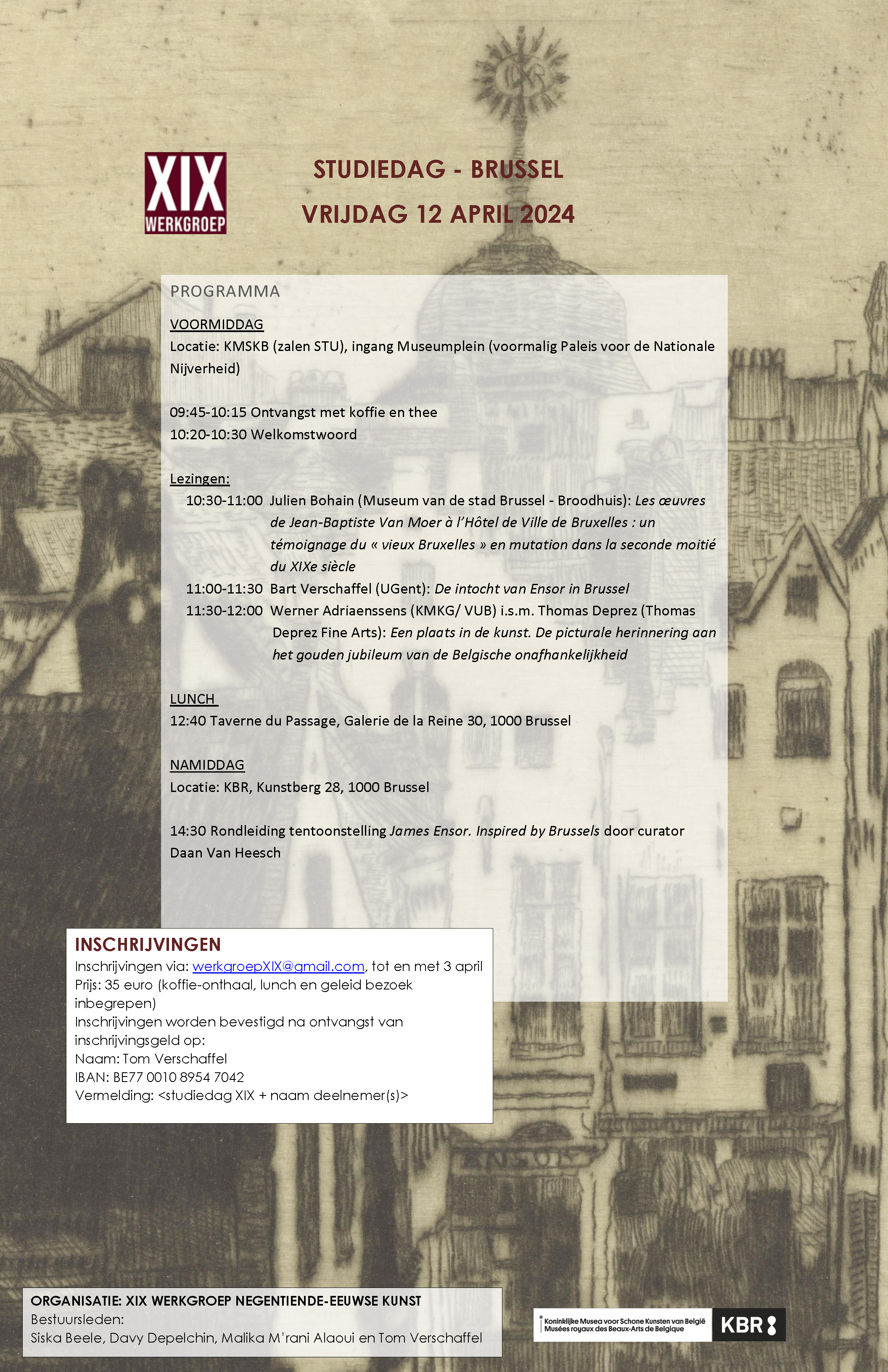
Interuniversitaire en intermuseale studiedag XIX

Werkgroep XIX
KMSKB, zalen STU, ingang Museumplein (voormalig Paleis voor de Nationale Nijverheid)
Vrijdag 12 april 2024
Inschrijvingsdeadline: 3 april 2024


Op vrijdag 12 april 2024 vindt de jaarlijkse studiedag van de Werkgroep XIX plaats in Brussel. We ontvangen u graag vanaf 9u45 in de KMSKB (zalen STU, ingang Museumplein (voormalig Paleis voor de Nationale Nijverheid)). Het programma omvat drie interessante lezingen in de voormiddag, een gezamenlijke lunch en een geleid bezoek aan de KBR in de namiddag.

Bovenstaande vindt u het volledige programma en de praktische modaliteiten voor de inschrijving.

Om de kosten van de organisatie te dekken zijn wij verplicht een bijdrage van €35 per persoon aan te rekenen. Locatie, middagmaal e.d.m. zijn daarin inbegrepen. De rekeninggegevens voor betaling per overschrijving zijn vermeld in het programma.

Alle geïnteresseerden zijn van harte welkom. Inschrijvingen lopen tot en met woensdag 3 april.

dinsdag 20 februari 2024

CFP: Dutch Bargains and Belgian Sales: Making a Market for Art from the Low Countries in the Americas, c. 1840-1920

Dutch Bargains and Belgian Sales: Making a Market for Art from the Low Countries in the Americas, c. 1840-1920

The Hague, RKD - Netherlands Institute for Art History, 21 June 2024


In a letter written in March 1853, the Belgian art dealer Ferdinand De Braekeleer jr. asked support from the Belgian government for his recently established art gallery in New York, which specialised in the import of contemporary Belgian and Dutch art in the US: ‘The taste for arts,’ he wrote ‘which was far removed from what it is now only a couple of years ago, is increasingly showing itself; the American travels more and more often to Europe and begins to form a taste for collecting.’ De Braekeleer’s words were almost literally echoed in a notice devoted to his gallery published two years later in the Cincinatti Gazette: ‘We have but to look back a few years, to recall the period, when a valuable painting from the hands of a European artist was esteemed in New York, a great rarity. […] But now, with that rapidity of progress characteristic of Americans, New York has become an important mart for works of the most elevated order, and of the highest artistic genius in Europe.’ 

The late 1840s and early 1850s were, indeed, a most promising time for art dealers and other agents from Europe: they heralded in an age of mass-importation of European art that brought tens of thousands of work art from the so-called old world to the new one and had a lasting impact on collections in America, both public and private. Research on the Transatlantic art trade, however, has been limited in scope: most scholars have concentrated their efforts on a small number of star collections, generally focussing on the trade in famous Old Master and contemporary French art (both academic and avant-garde). The import of contemporary art from the Low Countries – Belgium and the Netherlands – has received very little attention. 

Yet it is clear from articles and notices in newspapers and periodicals on both sides of the Atlantic that dealers and artists from the Low Countries quickly came to see America as the Eldorado of the rapidly internationalising art world and oriented their endeavours accordingly. Dutch and Belgian dealers and art promotors built new markets for their art and shipped hundreds, sometimes even thousands, of works to the US, Canada and Latin America; they recommended the Dutch and Belgian schools to collectors and museum officials, organized exhibitions and other temporary displays, or guided American collectors on their voyages through the Low Countries. Dutch and Belgian artists, in the meantime, also avidly eyed the American market: they networked with collectors, adapted their work to local taste, and sometimes even engaged in the mass-production of repetitive works all destined for export across the ocean. 

For this study day we would like to bring together scholars engaged in research on the art trade between the Low Countries and the Americas between ca. 1840 and 1920, the various actors involved (including artists, dealers, patrons, museum professionals, …), and the diverse sets of strategies and practices they employed in the Transatlantic promotion of contemporary Dutch and Belgian art. Please send proposals (max. 200 words) for an (informal) 20-minute paper (in Dutch, English or French; preferably delivered in person; if not digitally) to jandirk.baetens@ru.nl, devisser@rkd.nl and/or ulrike.muller@uantwerpen.be by 7 April 2024 at the latest. The convenors hope to publish (a selection of) the research presented in a special issue of a scholarly journal devoted to this topic. 

Jan Dirk Baetens (Radboud University), Evelien de Visser (RKD – Netherlands Institute for Art History) and Ulrike Müller (University of Antwerp – Royal Museums of Fine Arts of Belgium)